Why Epoxy Garage Floors Are a Smart Upgrade for Melbourne Homes
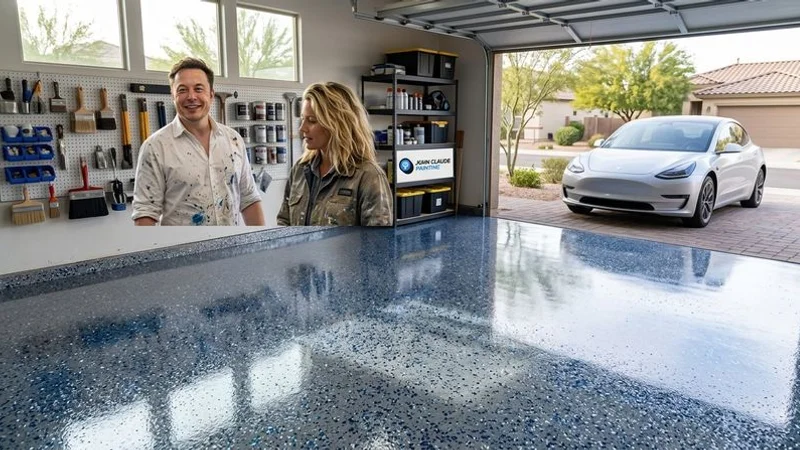
The garage is the hardest-working slab in most Melbourne homes. It parks cars still hot from the Monash Freeway, catches oil drips and brake dust, stores the mountain bike, and doubles as a workshop on weekends. Under all that use, bare concrete slowly loses the fight.
A professional epoxy floor coating turns that dusty, stained slab into a sealed, hard-wearing surface that wipes clean and actually looks good. Here is what the Paul Painting Melbourne team wants homeowners to understand before committing to a system.
What Bare Concrete Is Actually Doing to Your Garage
Concrete feels solid, but it is effectively a hard sponge. Every day it sheds a fine dust, absorbs oil drips, wicks moisture from the ground, and gives fine grit a place to hide.
A few patterns we see constantly on Melbourne garage inspections:
- Grey dust on cars and shelves from the slab itself slowly powdering.
- Dark oil shadows that never properly come out, even after degreasing.
- Moisture staining near the roller door from winter rain getting pushed inside.
- Efflorescence (white crystalline bloom) where ground water is tracking up through the slab.
A coated floor fixes all of this at once by sealing the pores of the concrete under a tough polymer film.
Why Epoxy Makes Sense in the Melbourne Climate
Hot-Tyre Resistance
Even with our comparatively mild summers, a tyre that has spent half an hour on a 55°C asphalt road arrives in the garage very hot. Cheap DIY coatings soften under that heat, stick to the rubber, and peel off the slab in flakes. We see this constantly on floors that were DIY-rolled with a supermarket kit.
Professional 100% solids epoxy cures far harder and handles that hot-tyre stress without lifting.
Moisture Management
Melbourne winters push a lot of moisture up through ground slabs, especially in older brick garages built on pads without a proper damp-proof membrane. A correctly installed epoxy floor includes a moisture-tolerant primer that lets the slab breathe while still sealing the top.
This matters because it stops:
- Vapour transmission lifting the top coat
- Efflorescence salts bleeding through the finish
- Mould taking hold under stored items
Chemical Resistance
The right system shrugs off every fluid a garage commonly sees:
- Engine oil, transmission fluid, and coolant
- Brake fluid and petrol drips
- Battery acid (if cleaned promptly)
- Driveway sealers and degreasers
Clean-up becomes a paper towel and a splash of warm water instead of an endless scrub on bare concrete.
UV Stability at the Roller Door Line
One spot most homeowners overlook is the apron right under the roller door. Every time the door opens, that strip takes direct UV. Standard epoxy ambers (turns yellow) under UV within a year or two.
We specify a polyaspartic UV-stable topcoat over the epoxy base specifically so the colour stays consistent from the back wall right out to the threshold.
Epoxy System Options
Solid Colour Two-Coat Epoxy
The simplest professional system. A primer plus a pigmented topcoat in your chosen colour.
- Best for: Clean, minimalist looks. Budget-conscious jobs.
- Thickness: Around 500 microns.
- Lifespan: 6 to 10 years with reasonable care.
Decorative Flake Broadcast (Our Most Popular)
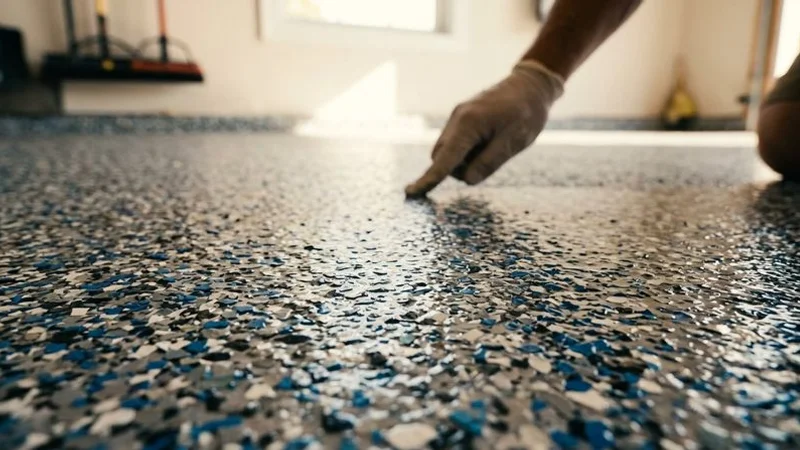
This is the system most Melbourne homeowners end up choosing. Coloured vinyl flakes are broadcast into a wet base coat, then sealed under a clear polyaspartic topcoat.
- Moisture-tolerant primer
- Pigmented base coat (100% solids epoxy)
- Flake broadcast to full refusal
- Clear UV-stable polyaspartic topcoat
The texture hides dust beautifully, gives good slip resistance in winter when cars drip rainwater, and the flake blend can be customised to match your home.
| Spec | Value |
|---|---|
| Total build | 800 to 1200 microns |
| Lifespan | 12 to 15+ years |
| Return to foot traffic | 24 hours |
| Return to vehicle | 48 to 72 hours |
Metallic Epoxy
A show-floor finish that creates a flowing, marbled, high-gloss surface. Popular for display garages, home gyms, and converted workshops.
- Visual effect: Glass-like, deep-gloss, unique pattern.
- Maintenance: Slightly more demanding; scratches show more than on flake systems.
- Best for: Climate-controlled spaces rather than daily-driver garages.
The Installation Process
Proper prep is 70 to 80% of the job. Acid etching a Melbourne garage slab is not enough; the concrete is usually too hard and too dense for that chemistry to bite.
Day 1: Mechanical Preparation
- Diamond grinding with a vacuum-shrouded planetary grinder. This opens the pores of the concrete and creates the surface profile the primer needs.
- Crack repair with a polyurea crack filler that cures fast and grinds flush with the slab. Cracks in older Melbourne slabs are common and need sealing, the same way render cracks get addressed on an exterior job.
- Moisture testing using a calcium chloride or relative humidity probe on any slab younger than 90 days.
- Vacuum clean to bare, dust-free concrete.
Day 2: Primer, Base and Broadcast
- Moisture-tolerant primer rolled to the edges and allowed to wick into the pores.
- Pigmented 100% solids epoxy applied in the base coat.
- Flakes broadcast into the wet base to full refusal while the chemistry is still open.
Day 3: Scrape, Vacuum, Topcoat
- Loose flakes scraped and vacuumed flush.
- Clear polyaspartic UV-stable topcoat applied, sometimes with a clear second coat for additional build on heavily used floors.
- Walk-on in 4 to 6 hours; park your car in 24 to 48 hours depending on conditions.
DIY Kits vs Professional Systems
You can buy a garage floor kit from Bunnings for a couple of hundred dollars. We get calls to grind those kits off within 18 months more often than we would like.
| Factor | Supermarket Kit | Professional System |
|---|---|---|
| Product base | Water-borne, 40 to 50% solids | 100% solids epoxy + polyaspartic |
| Prep method | Acid etch (inadequate) | Diamond grinding (mechanical bond) |
| Film build | 100 to 150 microns | 800 to 1200 microns |
| Hot-tyre resistance | Low | Excellent |
| Typical lifespan | 1 to 3 years | 12 to 15+ years |
| Warranty | None | 5 to 10 years |
The do-overs cost more than doing it properly the first time, because the failed coating has to be ground off before any new system can be laid.
Maintenance That Keeps Epoxy Looking New
Epoxy is low-maintenance, not zero-maintenance. A few habits will keep it looking new for a decade plus:
- Sweep or leaf-blow weekly to remove grit that acts like sandpaper under tyres.
- Mop monthly with warm water and a small splash of pH-neutral floor cleaner. Avoid sugar soap or harsh detergents.
- Wipe spills promptly so contaminants do not sit on the film for days.
- Use a welding blanket if you do metalwork. Molten slag will burn the topcoat.
- Park a walk-off mat just inside the roller door to catch stones before they get ground in.
Is Epoxy Right for Your Garage?
Epoxy is a brilliant upgrade for almost every Melbourne garage, but it is not the right answer if:
- Your slab has ongoing rising damp that has never been addressed.
- The concrete is so badly cracked or spalled that repair costs approach the coating cost.
- You plan to rip out the garage within the next couple of years.
For everyone else, it is one of the highest-impact improvements you can make for a relatively modest spend. If you are weighing up your options, contact Paul Painting Melbourne for a free on-site inspection and a proper quote.
Paul Painting Melbourne Team
Dulux Accredited Painting Contractor
Need Professional Painting Help?
Get a free, no-obligation estimate from our experienced team.
Get Free Estimate