When Should You Paint the Outside of Your Melbourne House?
Paint chemistry is surprisingly fussy about weather. Apply a premium acrylic on the wrong day and the film never properly forms. Get the conditions right and the same product will protect your home for a decade or more.
Melbourne’s infamous “four seasons in one day” makes this trickier than most Australian cities. What looks like a perfect morning can easily become a wet afternoon by the time the second coat goes on. Here is how we at Paul Painting Melbourne think about timing for exterior painting projects across the city.
The Prime Painting Window
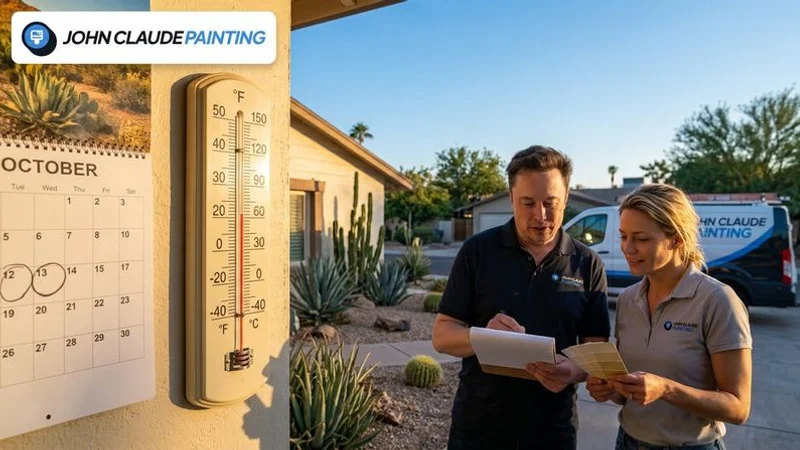
If you have flexibility on scheduling, aim for mid-October through late April. Daytime temperatures through this window typically sit between 15°C and 28°C, which is the sweet spot for almost every quality acrylic exterior system.
Inside that broad window, different months have different personalities:
- October and November are excellent. Winter damp has finished lifting out of the walls, days are getting longer, and the schedule is less crammed than the autumn rush.
- December and January are peak conditions but the diary is tight. If you want work done before Christmas you need to be talking to painters by September.
- February and March are often the single best stretch. Humidity is low, nights are still mild enough for overnight cure, and the arvo storms that hit earlier in summer have usually eased.
- April can be beautiful, but you start losing daylight and the risk of a wet week increases as you move toward winter.
Why Winter Painting Is Complicated (Not Impossible)
May through September is the hardest stretch for exterior work. It is not that paint cannot be applied in winter. It is that three things conspire against you:
- Overnight temperatures. Most quality acrylic exterior products need a minimum of 10°C on the surface for cure. Inner Melbourne routinely drops below that after sundown through winter.
- Dew and rain. Morning dew sits on surfaces until late, and cold fronts can roll through with little warning.
- Curing speed. Cold paint cures much slower, meaning the time between coats stretches out and a job that would take four days in February can take nine days in July.
Winter projects are still possible on protected, sun-warmed elevations, and some products (like Taubmans All Weather, rated for surface temperatures down to 5°C) are specifically formulated for the shoulder season. We do winter work, but we plan it carefully and we are honest with clients about the risks.
Understanding Surface Temperature vs Air Temperature
The number that really matters is the surface temperature of the wall, not the air temperature. A north-facing render wall in direct sun can sit 15°C hotter than the ambient air, while a south-facing wall in shade can be 5°C cooler.
On a warm summer day the north side of a Melbourne home can hit 45°C surface temperature by 2pm. Applying paint at that temperature causes “flash drying”: the water evaporates so fast that the film does not level properly and the resin cannot form a continuous layer.
We carry an infrared thermometer on every job and shoot the wall before we spray. If the surface is out of the product’s specified range, we wait or we move to a different elevation.
What “Perfect” Conditions Actually Look Like
The manufacturer specs across major Australian paint lines converge on roughly these numbers:
| Factor | Ideal | Acceptable | Red Zone |
|---|---|---|---|
| Air temperature | 15°C to 25°C | 10°C to 30°C | Below 8°C or above 32°C |
| Surface temperature | 15°C to 30°C | 10°C to 35°C | Below 10°C or above 40°C |
| Relative humidity | 40% to 60% | 30% to 75% | Above 85% |
| Wind speed | Light breeze | Under 20 km/h | Over 30 km/h (overspray risk) |
| Rain forecast | Nil for 24 hrs | Nil for 12 hrs | Any within 4 hrs of application |
The wind figure catches people by surprise. A stiff southerly across a two-storey weatherboard home will drive spray overspray onto the neighbour’s car, and it pushes the paint off the roller before it has time to level properly.
Techniques for Year-Round Painting
Sometimes waiting for the perfect month is not an option. Maybe the render is peeling, a real estate agent needs the home ready to list, or the body corporate has booked a settlement date. Here is how we manage projects in less-than-ideal windows:
Chasing Shade Around the House
We plan the day’s work so the wall we are painting is in shade at application time. North elevation first thing in the morning, east after smoko, south over lunch, west in the afternoon. It sounds obvious but it makes a big difference on hot days.
Starting Early
On warm days we kick off at sunrise and aim to finish cutting and rolling before 1pm. Nothing gets applied to a sun-baked wall in the middle of the afternoon.
Protected-Elevation Winter Work
On cold weeks we focus on north-facing and protected walls that spend the day above the minimum cure temperature, and leave the south and west elevations for spring.
Product Selection
For shoulder-season jobs we sometimes specify low-temperature rated products (Taubmans All Weather, Dulux Weathershield) rather than building-grade acrylics, because they tolerate a wider application range.
Related Risks Unique to Melbourne
Alkaline Render
New or patched render sits at a pH near 12. Painting directly over that chemistry will “burn” a standard topcoat and cause peeling within months. We always test pH and apply an alkali-resistant primer before finish coats on fresh render repairs.
Salt-Laden Coastal Winds
Homes near Port Phillip Bay deal with salt carried inland on southerly winds. We wash these walls thoroughly before painting and specify marine-grade systems for properties within a few streets of the water.
Old Lead-Based Coatings
Pre-1970 weatherboard and brick homes often have lead paint somewhere in the stack. Before sanding or pressure washing, we check suspicious layers and follow safe work procedures if lead is present.
How to Book the Right Slot
The unglamorous truth is that booking early matters more than choosing the “perfect” month. Most Melbourne exterior painters, ourselves included, have the October to April calendar partially booked by winter. Getting in touch three to four months ahead of when you want the work done is the most reliable way to land a prime weather slot.
If you are planning an exterior repaint for the coming season, contact Paul Painting Melbourne for a free inspection and quote. We will give you a realistic timing recommendation based on the condition of your walls and the elevations involved, not just whatever month is convenient.
Paul Painting Melbourne Team
Dulux Accredited Painting Contractor
Need Professional Painting Help?
Get a free, no-obligation estimate from our experienced team.
Get Free Estimate